phone: +974 4 409 5443 | 50024300
email: [email protected]
SHOP NUMBER 1,BUILDING NUMBER 2,BARWA VILLAGE,WAKRA


What Is Flicker in LED Lights and Why Does It Matter?
What Is Flicker in LED Lights and Why Does It Matter?
LED lighting has become a popular choice for homes, offices, commercial spaces, warehouses, and industrial environments because of its energy efficiency, long lifespan, and reliable performance. However, one important factor that is often overlooked when choosing LED lights is LED light flicker.
LED light flicker refers to rapid fluctuations in the brightness or light output of an LED source. Some flicker may be visible to the human eye, while other forms occur at frequencies that are difficult to notice. Understanding LED light flicker can help businesses and professionals make better decisions when selecting lighting solutions.
What Is LED Light Flicker?
LED light flicker occurs when the light output of an LED lamp or fixture repeatedly changes over a short period.
LEDs respond very quickly to changes in electrical current. As a result, fluctuations in the power supply or the operation of the LED driver can cause variations in light output.
The quality and design of the LED driver play an important role in controlling LED light flicker and maintaining stable illumination.
What Causes LED Light Flicker?
There are several common causes of LED light flicker:
1. Poor-Quality LED Drivers
An LED driver regulates the electrical current supplied to the LED. Poor-quality or unsuitable drivers may provide inconsistent current, resulting in increased LED light flicker.
2. Power Supply Fluctuations
Unstable electrical power can cause the brightness of an LED fixture to fluctuate. This can be particularly important in commercial and industrial environments where multiple electrical loads operate at the same time.
3. Incompatible Dimmers
Not every LED light is compatible with every dimming system. Using an unsuitable dimmer can result in LED light flicker, especially when the light is operated at lower brightness levels.
4. Low-Quality Components
The performance of an LED fixture depends on several components, including LED chips, drivers, capacitors, and other electronic parts. Low-quality components may contribute to flickering and reduced product reliability.
Why Does LED Light Flicker Matter?
LED light flicker is more than just a technical specification. It can influence the comfort, performance, and suitability of lighting in different environments.
Visual Comfort
Excessive LED light flicker may cause visual discomfort for some people, particularly during prolonged exposure. Selecting quality LED products with good flicker performance can help create a more comfortable lighting environment.
Workplace Lighting
Offices, schools, retail stores, and industrial facilities often use lighting for many hours each day. Stable lighting can contribute to a more comfortable visual environment for employees and customers.
Cameras and Video
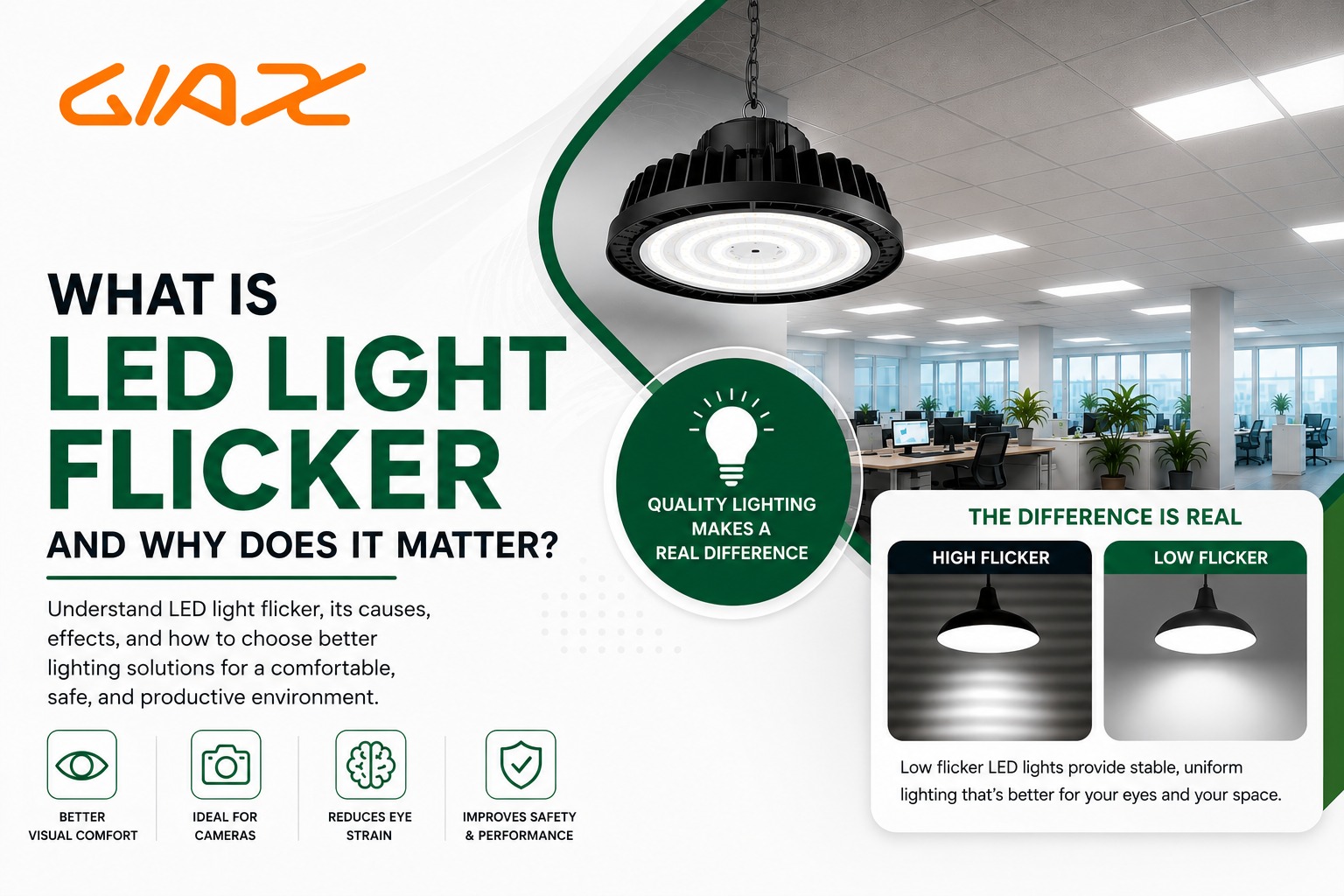
LED light flicker can also affect cameras and video recordings. Depending on the flicker frequency and camera settings, flickering may appear as horizontal bands, brightness variations, or other unwanted visual effects.
This makes flicker performance particularly important in areas using CCTV cameras, photography, video production, and digital displays.
Industrial Applications
In certain industrial environments, LED light flicker can contribute to a stroboscopic effect. Under specific conditions, moving or rotating machinery may appear to move differently than it actually does.
For industrial lighting applications, low-flicker LED solutions can therefore be an important consideration alongside brightness, beam angle, efficiency, durability, and IP protection.
Visible and Invisible LED Flicker
Not all LED light flicker is easily visible.
Visible flicker occurs when changes in brightness can be directly noticed by the human eye. The light may appear to pulse or fluctuate.
Invisible or less noticeable flicker can occur at higher frequencies. Although it may not be immediately noticeable, it can still be relevant for applications involving cameras, moving machinery, or sensitive visual tasks.
Therefore, simply looking at an LED fixture and deciding that it does not flicker is not always enough to evaluate its overall flicker performance.
How Can You Reduce LED Light Flicker?
When choosing LED lighting, consider these factors:
- Select LED products from reliable manufacturers.
- Choose fixtures with high-quality LED drivers.
- Check the manufacturer's flicker specifications where available.
- Ensure LED fixtures are compatible with the intended dimming system.
- Use suitable drivers and power supplies.
- Consider low-flicker LED products for offices, industrial facilities, studios, and camera-monitored spaces.
- Consult professional lighting suppliers for application-specific recommendations.
Choosing the Right LED Lighting Solution
LED light flicker is only one factor to consider when selecting a professional lighting system. A good LED solution should offer the right combination of brightness, colour temperature, energy efficiency, colour rendering, driver quality, durability, and application suitability.
For example, a warehouse may require high-output LED lighting with appropriate beam distribution, while an office may place greater emphasis on visual comfort and uniform illumination.
Selecting the right product for the right application is essential for achieving reliable and efficient lighting performance.
Reliable Lighting Solutions from GIAX
At GIAX, we understand that professional lighting is about more than simply producing light. A well-designed lighting solution should provide reliable performance, energy efficiency, comfort, and suitability for the intended environment.
Whether you are planning lighting for commercial spaces, offices, retail environments, warehouses, industrial facilities, or other applications, choosing quality LED products and suitable components can make a significant difference.
When evaluating LED lighting, don't only ask, “How bright is it?” Consider “How stable, efficient, and suitable is the light for the application?”
Understanding factors such as LED light flicker can help you make more informed lighting decisions and create better-lit spaces.
Final Takeaway
LED light flicker is the rapid fluctuation of light output that can result from power variations, LED driver design, dimming systems, or component quality. While some flicker may be difficult to see, it can still be an important consideration for visual comfort, cameras, workplaces, and industrial applications.
Choosing quality LED products with suitable drivers and specifications can help achieve stable, reliable, and efficient lighting performance.
Better lighting starts with better choices — and understanding LED light flicker is an important part of choosing the right lighting solution.
GIAX — Reliable Lighting Solutions for Every Application.